

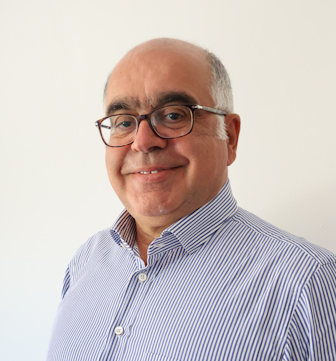
Michele Ippolito
Head of Real Estate
Spanning some major industrial organisations, his career is built on hands-on experience of operational challenges with increasing responsibilities. Michele Ippolito, currently Head of Real Estate at Leonardo Global Solutions, describes a leadership model based on discipline, empowering people and continuous improvement. In a rapidly evolving environment, he shares his strategic priorities and his vision for tackling future challenges.
Your long career has covered a wide range of industrial sectors. Which experiences have played the biggest role in shaping your managerial approach and your business vision?
It's not easy to single out the most formative experiences, as every stage has contributed significantly to my professional growth. The foundations were laid at Lamborghini, where I developed my technical skills and approach.
A turning point came when I was appointed plant manager in Bari at the age of 35: a challenge requiring a significant leap in managerial ability that proved to be my first real test in the field.
Then my experience in Operations at Campi Bisenzio marked another milestone. In a complex environment, we had to implement a radical restructuring plan, reorganising activities around three fundamental pillars: production planning and control, industrial engineering and the factory. The restructuring was underpinned by well-defined roles, clear and shared objectives, and strict monitoring of the key drivers: quality, lead times and costs.
This approach is based on one key principle: continuous improvement. Every result achieved becomes the starting point for the next phase of growth.
How has your approach to leadership evolved since joining the Group in 2004?
I define leadership in its most practical sense, namely ‘steering the ship’. That means taking responsibility for our direction, staying on course even during the most challenging times, and setting a consistent example.
At Leonardo, I've had the opportunity to work alongside world-class managers, from whom I've learnt a great deal. This is a key asset of the Group, and one we should keep in mind.
My approach has evolved over time in line with organisational circumstances. Initially, when the focus was very much on the site, key aspects of management included a direct presence and daily contact with people. With the establishment of what was then Selex Galileo and its international integration, we needed to develop a more open style, geared towards dialogue and the exchange of ideas, as demonstrated by the introduction of Integrated Project Teams.
Later, the expansion of our scope called for more sophisticated models: streamlined central functions with a steering role, and sites organised as centres of excellence. This has encouraged both specialisation and the strengthening of expertise.
Nevertheless, I believe the principle remains the same: leadership is first and foremost about the ability to bring out the best in people. They are the main driving force behind creating value. Maintaining a constant dialogue that is open to all is an integral part of this approach.
What are the main challenges and opportunities in your new role?
The transition from customer to supplier brings a significant shift in perspective. This experience lets you re-evaluate processes with greater awareness and a focus on results.
The main challenge is to understand customer expectations in ever greater detail and translate them into effective, timely, consistent services. We need to adopt a truly integrated customer-supplier approach, understanding requests from the perspective of those making them.
One critical factor is aligning with their timeframe: for our industrial partners, ‘time’ means now. So responding quickly and efficiently is an essential competitive advantage.
You are big fan of motor racing – a world where technology, expertise and teamwork make the difference. Are there any lessons or principles you have learnt from this world that can also be applied to managing complex organisations?
Motor racing is an extremely effective example of technology, expertise and teamwork coming together. It is the most tangible expression of continuous improvement and the perfect synergy between design and execution.
The principles applicable to business are plain to see: clarity of objectives, the ability to identify areas for improvement, rigorous planning and swift execution.
in complex organisations, just as in motor sport, the result is the fruit of a collective effort, directed towards a common goal: in this case customer satisfaction.
Any message you'd like to share?
Leonardo Global Solutions is a service provider that supports the Group. We must approach this role with a fully market-oriented approach: delivering services of ever-increasing quality, with ever-greater efficiency.
Our aim is to be recognised as a strategic partner. One that makes a tangible contribution to the growth of the business through expertise, reliability and operational excellence.