

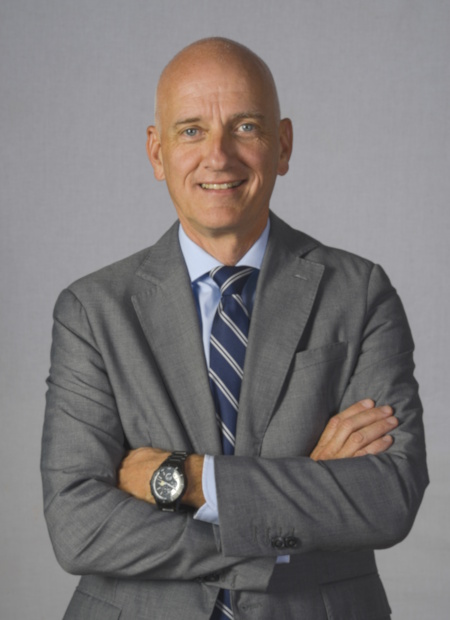
Mauro Martinelli
Head of Facility Management & Site Services Business Unit
Facility Management is taking on an increasingly central role in corporate strategies.
It is evolving from an operational function into a driver of development and innovation, combining efficiency, sustainability, and a focus on people.
Let's take a closer look at the journey, the challenges, and the vision behind this evolution, considering cultural shifts, digital transformation, and upskilling.
You've seen a lot of changes during your career in Facility Management. Which of these has been the most significant, and what challenges have you faced along the way?
The most significant change was undoubtedly in 2015, when Leonardo, then still Finmeccanica, decided to centralise its facility services under Leonardo Global Solutions (LGS).
These had previously been managed by individual companies within the Group, so it was a fundamental change for our company, enabling it to expand its scope of activity, which until then had been mainly focused on purchasing.
Lots of colleagues joined the company from different areas of the Group, bringing with them a wealth of experience that became an essential tool in LGS's growth.
The first challenge was to integrate these new and diverse skills and create a 'common language' to unify service requirements and create a standard Group model.
The robustness of the processes we put in place and our constant focus on the customer are the strengths that have allowed LGS to take on a strategic role within the Group today.
Facility Management is taking on an increasingly strategic role for companies. How do the services it handles contribute to improving competitiveness and resilience, especially in a constantly evolving global marketplace?
Facility Management is no longer a support activity, as it was in the past.
It has truly become a strategic enabler. In a rapidly changing global environment, services now represent effective drivers for increasing companies' competitiveness and resilience.
Smart management of facilities and buildings can reduce consumption and unexpected breakdowns, thereby achieving greater manufacturing efficiency and cost optimisation.
But equally important is the contribution that facilities management can make to increasing people's well-being and productivity by creating comfortable spaces that are safe from both a physical and ergonomic point of view, with high-quality services aimed at improving employee satisfaction in the workplace.
One key example is our work on catering services, introducing new takeaway options and establishing partnerships to combat food waste, as well as redesigning company restaurants. And when it comes to resilience, let's not forget the crucial contribution made by Facility Services to business continuity during the pandemic.
In the context of Industry 4.0, digitisation and automation are transforming the sector. How do you view the integration of new technologies in Facility Management and what opportunities do they offer in terms of efficiency and customisation of services?
Digitalisation is literally transforming every sector, and that includes facilities management. Thanks to Internet of Things (IoT) sensors, Building Management Systems (BMS) for remote management of facilities, predictive maintenance and Digital Twin technology, it is now possible to continuously monitor facilities and consumption, detecting any anomalies in real time, predicting failures before they occur, simulating consumption scenarios and scheduling maintenance only when necessary, thereby reducing costs and downtime.
LGS recently activated the first BMS system for remote management and monitoring of general systems at its industrial site in Nola, which will make it possible to implement predictive maintenance.
Plans are currently underway to extend this system to other Group plants. It is not just about automating tasks, it is about completely transforming the way buildings, facilities and services are managed, making them smarter, more efficient and more business-oriented. In short, we are moving from a reactive approach to a predictive one, with decisions increasingly being based on data rather than assumptions.
Is there a message you would like to share?
LGS is a service company, and at its heart are its people.
They are the foundation of our customer relationships, which they build day after day through their experience, expertise and interpersonal skills.
That is why training and skills development, motivation, effective communication and engagement are all vital. Our company's success depends on empowering our people, because they represent LGS's added value.