

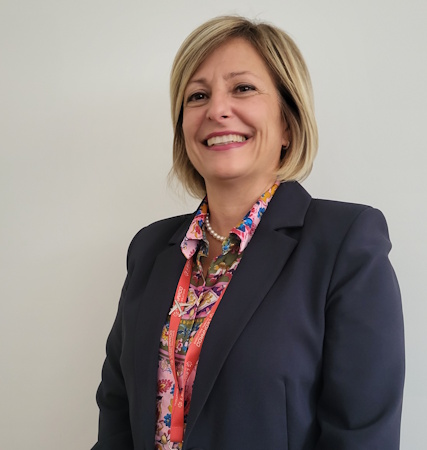
Maria Serena Antilici
Head of Organization, Recruiting & People Development
In a continuously evolving work environment, where technology plays an increasingly decisive role, we face the challenge of understanding training needs and envisaging new models. These must take into account the central role of the individual, whose professional identity draws not only on technical skills but also on human capital, which must be built and rebuilt throughout their career.
Training at Leonardo Global Solutions is…
An opportunity for both personal and professional growth. It represents our tangible commitment to empowering our people, enhancing their technical and cross-functional skills in line with company strategies, strengthening their ability to actively contribute to the company's objectives and more.
In an ever-changing industrial and technological environment, where our mission as a service provider for the Leonardo Group requires us to respond quickly, flexibly and effectively, training becomes a key enabler of change. It allows us to introduce new tools, new methods and new operating models, supporting the organisation's cultural and digital evolution.
Training is also a powerful tool for individual motivation. People who are learning and who feel supported in their development are more engaged, more proactive and more focused on improvement. So training means listening to, recognising and valuing each person's unique potential.
Training people means preparing them to take on different roles, face new challenges and respond readily to change. All this makes our organisation more flexible, more resilient and more capable of adapting quickly to external changes.
In summary, training is not only a driver of professional development, but also an essential component of our corporate identity. It is through the growth of individuals that we will build a stronger, more innovative and more sustainable future together.
How do you identify training needs and how do you measure their effectiveness?
Every year, we assemble and examine the training requirements of all company departments, following a structured process consistent with Leonardo Group guidelines. It takes into account the company's strategic objectives, organisational needs, and regulatory obligations, as well as individual professional development, starting from knowledge and skill gaps with respect to the way specific roles are evolving.
The process is supported by structured tools and is part of the Integrated Human Resources Management System. The training needs thus identified are also discussed in depth with managers, taking into account the results of the Competency Assessment carried out in relation to the Group Professional System, which assigns each person a professional role consisting of activities and skills, and the results of the Performance and Potential Assessment systems for alignment with the Group's management system.
Through this approach, we are able to identify and plan even more targeted and effective training and development programmes, considering every detail from objectives and targets to teaching methodology, teaching staff, costs and timescales. These are then added to the Company Training Plan. Examples include programmes focused on professional roles specific to our business (Procurement, Facility Management and Project Management) as well as Group initiatives aimed at enhancing managerial skills.
To fully meet individuals' needs for skills development linked to their professional interests or personal curiosity, rather than those strictly related to the role they perform, a wide and constantly evolving range of training courses is available to employees through the "Coursera" online training platform.
The organisation's strategic vision of training is confirmed by the decision to join the New Skills Fund designed to strengthen and develop the skills of its people in line with emerging professional needs in the areas of digital innovation, sustainability and organisational well-being.
How must organisational training evolve to respond to complexity, and to support both skills development and personal growth, accompanying people throughout their entire professional career?
Training in organisations needs to evolve from a static model to a continuous process that is personalised, strategic and capable of responding to the growing complexity of working environments. It should be seen as an integrated learning ecosystem that supports people over the course of their professional career.
To effectively support skills development, there is a need for a flexible, modular approach that takes into account individual needs as well as organisational changes. That means designing dynamic, updatable training programmes that combine face-to-face sessions, digital learning, field experience and mentorship.
At the same time, training must promote personal growth and well-being, developing not only specialist expertise but also cross-functional skills to enhance managerial abilities.
Training plays a fundamental role as a support tool, guiding people through key moments in their careers, from onboarding and role changes to generational transitions and new business challenges.
We need the kind of training that listens, anticipates, engages and empowers, creating the conditions for people to learn continuously, to feel like active participants in change, and to contribute more consciously to the success of the organisation.
Looking ahead, how do you think technology (e.g. artificial intelligence, advanced e-learning, and augmented reality) will influence the way training is designed and delivered in companies?
Technology is already a key component of corporate training, making it more personalised, immersive, flexible and data-driven.
Artificial Intelligence (AI) already makes it possible to personalise training courses based on individual skills, learning styles and objectives, while chatbots and virtual assistants provide continuous and immediate support, making learning more accessible and responsive. Moreover, algorithms analyse participant data to optimise content, timing and delivery methods.
Advanced e-learning – using increasingly interactive platforms based on dynamic content, gamification and virtual communities – promotes continuous, scalable and flexible learning. Micro-learning, meaning short, targeted modules that can also be accessed on mobile devices, improves skill retention and enables “just-in-time” training that can be easily integrated into daily work activities.
Virtual Reality (VR) and Augmented Reality (AR) are now operational in various companies, allowing complex or dangerous environments to be simulated in complete safety through immersive, practical experiences. They are particularly effective in developing both hard skills (such as maintenance, plant management, technical operations) and soft skills (such as leadership, communication, empathy), thanks to the opportunity they provide for practising in realistic scenarios.
Data collection and analysis are also revolutionising how we assess the impact of training, enabling us to better understand what works and what does not, and to quickly adapt content and strategies accordingly. In this environment, the role of training is also evolving towards that of a facilitator of experiences, a coach and guide for personalised career paths, taking on a more strategic role in promoting continuous, participatory and people-centred learning.
Is there a message you would like to share?
We live in a rapidly changing world, where the skills we need are quickly evolving and the challenges we face are constantly increasing. These days, learning is no longer a one-off event: it is a continuous process that helps us stay curious, up to date and ready to face the future.
We strongly believe in training and we invest in providing people with tools, spaces and opportunities to learn in an increasingly effective and engaging way. But the real value comes from within each one of us: training truly works when it becomes part of our daily lives, when we choose to get involved, discover something new and grow, one step at a time.
Investing in yourself is the best way to grow, seize new opportunities and make a difference by contributing to the growth of your team and the company.
Let's keep learning. Together.